
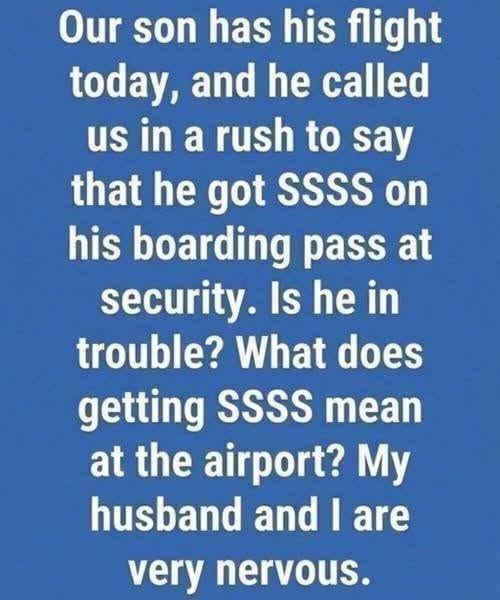
Does SSSS Mean You Will Miss Your Flight?
Not necessarily.
Many passengers go through additional security procedures and continue their journeys normally. The main issue is that secondary screening can take additional time.
How much extra time depends on factors such as the airport, passenger volume, staffing, the amount of luggage being inspected, and the specific screening procedures required.
This is why a passenger who knows in advance that SSSS appears on the boarding pass should avoid arriving at the last possible moment.
How Early Should You Arrive?
There is no single extra-time rule that applies to every SSSS passenger at every airport.
A sensible approach is to follow the airline’s recommended airport arrival time and add a comfortable buffer for additional screening.
This becomes particularly important at large international airports, during holidays, on busy travel days, or when checking baggage.
It is much better to spend extra time waiting near the gate than to become increasingly stressed while secondary screening is taking place shortly before departure.
Why Online Check-In May Sometimes Be Complicated
Some travelers first suspect that something is different when online or mobile check-in does not work as expected.
A passenger may be instructed to see an airline representative at the airport rather than receiving a normal mobile boarding pass.
There are many reasons why an airline can require airport check-in, however, including document verification, visa requirements, ticketing issues, destination rules, or operational reasons.
Therefore, being unable to obtain a boarding pass online does not by itself prove that you have been selected for SSSS.
The designation becomes clear when it is actually associated with the traveler’s boarding documentation or when airline or security personnel explain the additional-screening requirement.
What Should You Do at the Airline Counter?
If the airline tells you to check in at the airport, bring the travel documents required for your itinerary.
For an international journey, that generally means having your passport readily available along with any destination-specific documents required for the trip.
Answer routine questions accurately and allow the airline employee to complete the necessary verification.
There is usually little benefit in arguing with the check-in agent about why SSSS appeared. Airline employees generally cannot simply remove a security-screening designation because a passenger objects to it.
Can TSA PreCheck Prevent SSSS?
No trusted-traveler or expedited-screening program should be viewed as a guarantee that a passenger will never receive additional security screening.
Programs such as TSA PreCheck can provide expedited screening benefits to eligible travelers, but security authorities retain the ability to require additional screening when necessary.
If SSSS appears, passengers should follow the instructions provided for that trip rather than assuming their normal expedited procedure will automatically apply.
What About Global Entry?
Global Entry and SSSS relate to different parts of the travel process.
Global Entry is primarily an expedited international-arrival program for eligible, preapproved travelers entering the United States. TSA PreCheck benefits may also be available to eligible Global Entry members.
Membership does not mean a traveler is exempt from all security screening.
A trusted-traveler status therefore should not be interpreted as immunity from secondary screening.
Does SSSS Affect Checked Baggage?
The code primarily tells the passenger to expect additional security screening. Security authorities separately maintain procedures for screening checked baggage.
Travelers should therefore avoid assuming that the four letters provide a complete description of everything that may happen to their checked luggage.
The most visible difference for the passenger is usually the additional screening of the person and carry-on belongings.
What If You Have a Connecting Flight?
The answer depends heavily on the itinerary and where security screening occurs.
International travel can involve multiple airlines, airports, immigration authorities, and security systems. Passengers may also have to undergo security again during certain connections.
If you have SSSS and a tight connection, pay close attention to airline and airport instructions.
When booking future trips, allowing reasonable connection time is useful even without additional screening and becomes more valuable when extra procedures may occur.
Will You Be Questioned?
Additional security screening can involve questions, but the exact experience varies.
Routine questions should be answered accurately and calmly.
Travelers should not assume that being asked a question means they are accused of a crime. Identity and travel-document verification are normal parts of aviation security and international travel.
Will Your Phone Be Searched?
Travelers sometimes confuse airport security screening with border inspection.
They are not necessarily the same process.
SSSS concerns additional aviation-security screening. International passengers may separately encounter customs and border authorities, whose legal authorities and inspection procedures are different from the normal airport security checkpoint.
Consequently, stories about searches performed during immigration or customs inspection should not automatically be attributed to SSSS.
SSSS Is Not the Same as Immigration Screening
This distinction is particularly important for international travelers.
Aviation security is focused on protecting aircraft and transportation systems. Immigration authorities determine whether travelers satisfy entry requirements. Customs authorities enforce rules concerning goods entering a country.
Although these processes can occur during the same journey, they are legally and operationally distinct.
A person can complete aviation security normally and still face additional questions at the border, or receive secondary aviation screening and then complete immigration without unusual difficulty.
SSSS Is Not a Criminal Charge
Seeing the code does not mean you have been charged with an offense.
It does not appear on a boarding pass as a declaration that the passenger is guilty of anything.
It indicates additional screening.
That may still be frustrating or uncomfortable, but understanding the distinction can prevent unnecessary panic.
Can Children Receive Additional Screening?
Security requirements can apply to passengers of different ages, although screening procedures may be adapted according to applicable policies.
Families should follow instructions from security personnel and can ask questions if they are uncertain about how a child will be screened.
Parents should avoid frightening children by describing secondary screening as though someone is in trouble. A calm explanation that security officers need to perform additional checks can make the experience easier.
What If You Have a Medical Condition?
If you have a medical condition, implanted medical device, prosthesis, mobility limitation, or another circumstance relevant to screening, communicate with the security officer.
Do not conceal important information simply because you want the process to finish faster.
Passengers may also ask questions about how screening will be conducted and what accommodations are available under applicable procedures.
What If You Wear Religious or Cultural Clothing?
Airport security procedures apply to a diverse traveling population.
If additional screening creates a concern related to religious clothing, privacy, disability, or another personal circumstance, communicate respectfully with security personnel about the available screening options.
Do not remove items or take actions that have not been requested merely because you see SSSS on your boarding pass.
Can You Refuse Secondary Screening?
A passenger who wants to enter the secure area and board a commercial flight must satisfy applicable security-screening requirements.
If you decline required screening, you should not expect to be allowed to continue through security and board normally.
If you are uncomfortable with a particular procedure, ask the officer about available options rather than simply refusing all screening.
Why Staying Calm Helps
Additional screening is understandably annoying when you are tired, traveling with children, worried about a connection, or already running late.
But becoming confrontational rarely makes an airport process easier.
Keep documents accessible, listen carefully to instructions, answer legitimate questions accurately, and repack belongings only after officers have finished examining them.
A little organization can save time when several carry-on items need to be inspected.
Organize Your Carry-On Before Traveling
A cluttered bag can make any security inspection slower.
Consider keeping travel documents, electronics, charging equipment, liquids permitted under applicable rules, and other frequently inspected items organized and accessible.
Avoid packing prohibited items and check current security requirements before traveling.
Organization cannot prevent SSSS, but it can make additional screening less chaotic.
Receiving SSSS once may be an isolated selection—but seeing those four letters trip after trip is a different situation, and frequent travelers have several practical options to consider.