

“Someday, when you’re older,” he said, “you’ll decide what you want to do with it.”
Lily looked toward the waves.
“I want Grandma to have the big room upstairs,” she said.
From the kitchen, Evelyn pretended not to hear.
She wiped a tear from her eye.
And Marcus laughed—a genuine, easy laugh—for what felt like the first time in years.
That evening, they ate clam chowder on the porch.
Lily talked endlessly about her class.
Evelyn told an embarrassing story about Hannah as a teenager.
And Marcus felt a sense of peace returning to his life that he had once thought might be gone permanently.
Protecting his daughter, he now understood, did not mean spending the rest of their lives suspicious of everyone.
It meant creating a world safe enough that Lily could simply be a child again.
Before bed, Lily placed her little canvas backpack beside the bedroom door.
It was the same backpack she had clutched against her chest on the terrifying afternoon Marcus returned to Greenwich.
Marcus recognized it immediately.
“You still love that old backpack, huh?”
“Yep.”
“We could get you a new one for school, if you want.”
Lily shook her head.
“I like this one.”
Marcus did not push.
But Lily explained anyway.
“It’s the backpack I grabbed,” she said, “when you came back for me.”
Marcus stood still in the doorway.
He suddenly understood why she would not replace it.
To an adult, it was an old canvas backpack, worn and easily replaced.
To Lily, it represented something much larger.
It was the thing she had been holding during the most important moment of her young life.
The moment her father came back through the door.
The moment he took her hand.
The moment he led her away from the house.
The moment her frightened decision to trust him was rewarded.
That backpack was physical proof of the thing a frightened child needed most to know: when she finally found the courage to tell the truth, someone came for her.
It had been in her arms when her world changed from fear to safety.
So to Lily, it was no longer merely a backpack.
It was the memory of being rescued.
Marcus could have bought her a hundred new ones.
But none could replace what that old backpack carried.
Children sometimes keep objects adults do not understand because adults forget how enormous certain moments feel when you are small.
Lily had not forgotten.
Before closing her bedroom door, she looked up at her father and said five words that affected Marcus more deeply than any betrayal, court filing, or criminal charge ever had.
“I knew you would come back.”
Those words stayed with him as he walked outside onto the deck.
The ocean stretched dark beneath the moon.
For months, Marcus had thought the nightmare was about an estate worth millions, a fraudulent contract, and a woman who had entered his life because of greed.
But standing beneath the stars, he understood that the house, the money, Sarah, and Julian had always been secondary.
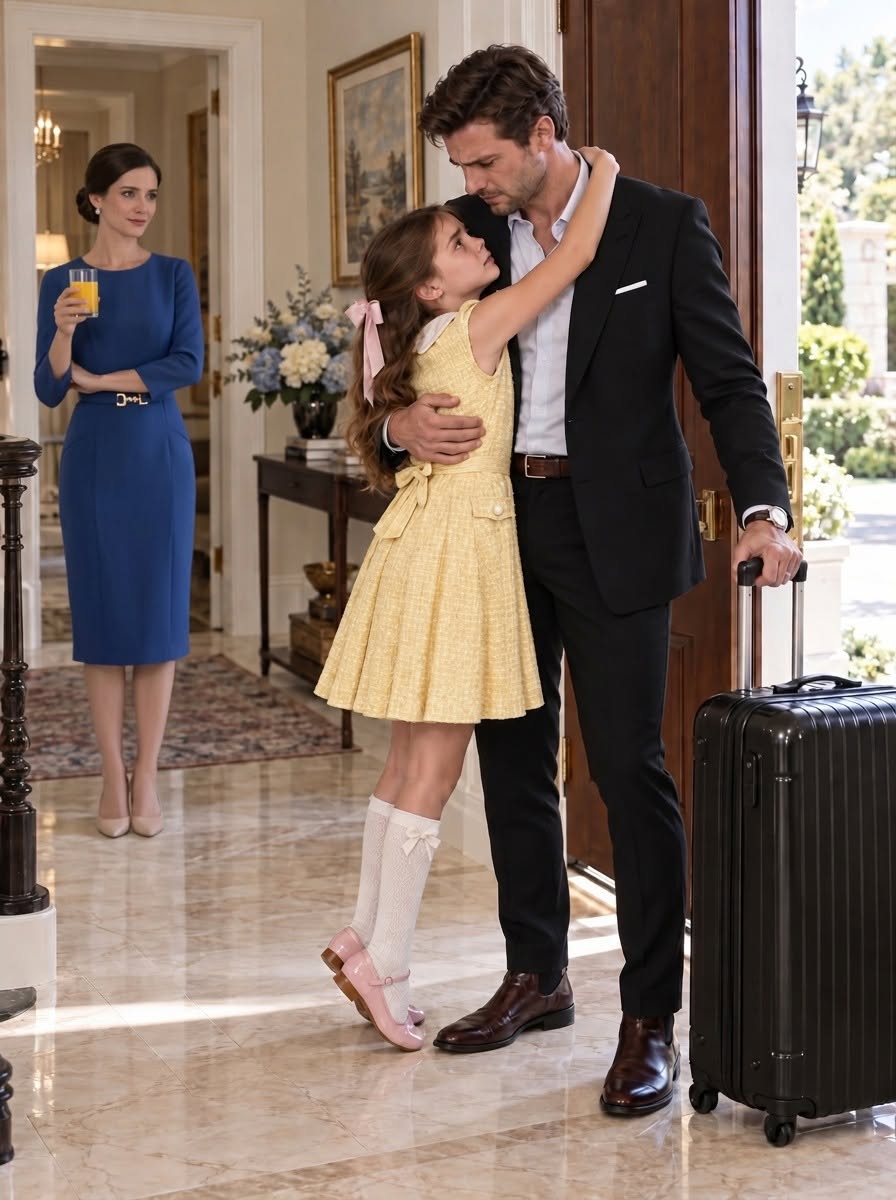
Everything important had started with a six-year-old girl wrapping her arms around her father’s waist in the hallway and finding enough courage to whisper:
Daddy, don’t leave today.
And everything that saved her changed in the moment Marcus stopped, knelt down, and listened.
Sarah had planned for almost everything.
She had studied Marcus’s grief, his guilt, his work schedule, and his trust.
She had anticipated the possibility that Lily might eventually speak and had tried to undermine the child’s credibility in advance.
The scheme had been carefully constructed and had come frighteningly close to succeeding.
But there was one variable Sarah could never fully control.
A six-year-old girl might find the courage to tell her father the truth.
And her father might believe her.
That was the weakness in the entire plan.
Sarah could manipulate documents.
She could manipulate recordings.
She could manipulate appearances and financial arrangements.
But she could not fully control the trust between Marcus and Lily.
“I knew you would come back.”
Lily had believed that because, throughout six years of ordinary parenting—school drop-offs, dinners, bedtime stories, grief, questions, comfort—Marcus had unknowingly taught his daughter that he would be there when she truly needed him.
He had spent years building the one protection Sarah could not purchase, forge, or plan around.
A child who trusted her father enough to tell him the truth.
And a father who was willing to stop and believe her.
Everything afterward—the lawyers, the recordings, the medical testing, the investigators, and the court proceedings—was simply the machinery needed to act on what that trust had made possible.
The property was secondary.
The money was secondary.
The criminals were secondary.
It had begun with Daddy, don’t leave today.
And it had been won in the moment Marcus knelt down to hear the rest.